
Rule of life
Our Rule of Life
The Rule of our Order was officially approved by Pope Honorius III in his bull of November 29, 1223 (see photo below). It should be noted that a bull (from the Latin “bulla,” meaning “seal”) is a document, originally sealed, through which the pope issues an important legal act. This rule, known as the “Rule Bullata,” is the definitive form of the “Life” initially presented by Francis and his brothers to Pope Innocent III in 1209. Despite its age, it remains the official rule of the Order of Friars Minor (Minorites, Conventuals, and Capuchins) to this day. It defines how we live in fraternity according to the charism desired by Saint Francis. It can be summarized as follows:
“To observe the Holy Gospel of our Lord Jesus Christ,
living in obedience, without any personal possessions, and in chastity.”
We present the full text below. An early version of this Rule, known as the “Rule non bullata,” was drafted in 1221.
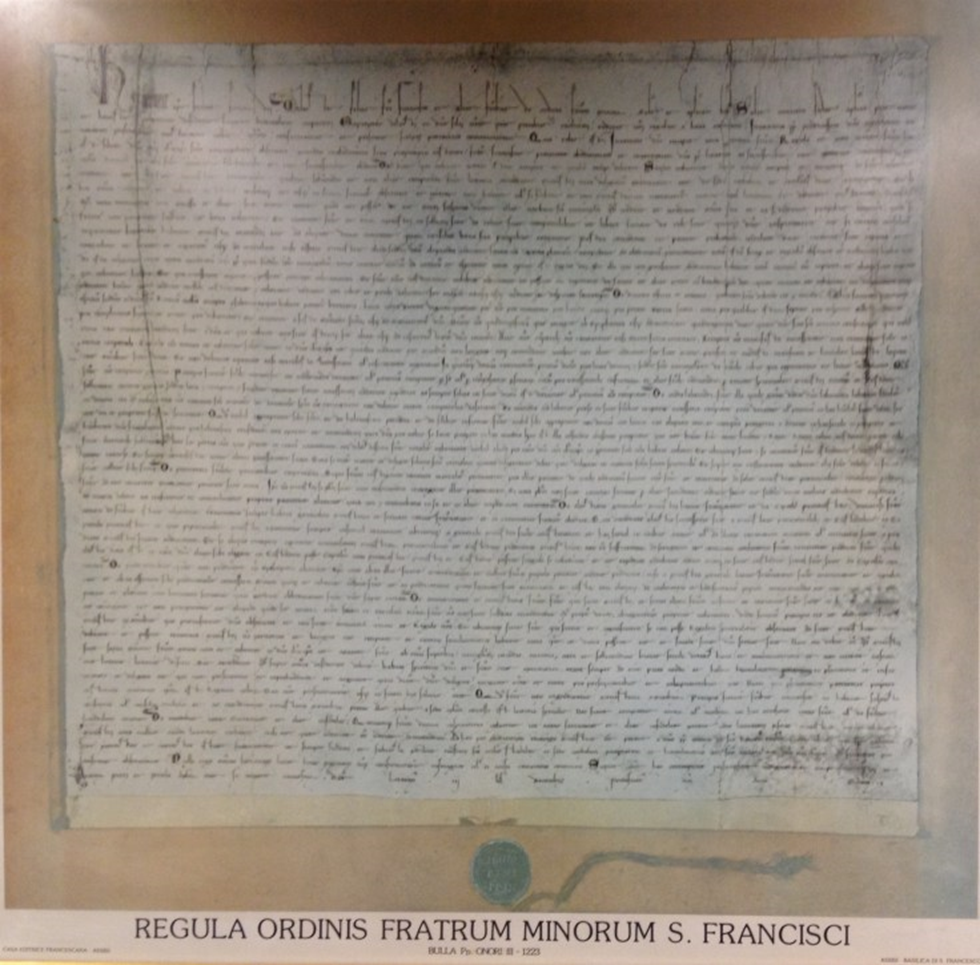
Rule of the Order of Friars Minor.
Honorius, bishop, servant of the servants of God, to the beloved sons, Brother Francis and the other brothers of the Order of Friars Minor, greetings and apostolic blessing. It is the custom of the Apostolic See to grant pious requests and to bestow its benevolent favor upon the just desires of those who ask. Therefore, beloved sons in the Lord, moved by your pious prayers, we confirm for you by apostolic authority and provide with the protection of this document the Rule of your Order, approved by our predecessor, Pope Innocent, of blessed memory, and hereby restored. This Rule is as follows:
1. Prologue.
The rule and life of the Friars Minor is this: to observe the Holy Gospel of our Lord Jesus Christ, living in obedience, without any personal possessions, and in chastity. Brother Francis promises obedience and reverence to Pope Honorius and to his canonically elected successors and to the Roman Church. And let the other brothers be bound to obey Brother Francis and his successors.
2. Of those who wish to embrace this life and how they are to be received
If there are any who wish to embrace this life and come to our brothers, let the latter send them to their provincial ministers, to whom alone—and to no one else—permission is granted to receive brothers. Let the ministers examine them carefully regarding the Catholic faith and the sacraments of the Church. And if they believe all this and wish to profess it faithfully and observe it steadfastly until the end, and if they have no wife, or if they have one and their wife has already entered a monastery, or if, having already taken a vow of continence, she has given them permission with the authorization of the diocesan bishop, and if their wife is of an age that does not arouse suspicion, let them tell them the word of the Holy Gospel, to go and sell all their possessions and to apply themselves to distributing them to the poor. If they cannot do so, their good will is sufficient. And let the brothers and their ministers take care not to concern themselves with their temporal goods, so that they may freely dispose of their goods as the Lord inspires them. If, however, they ask for advice, let the ministers have permission to send them to some God-fearing men, on whose counsel they will distribute their goods to the poor. After that, let them be granted the habit of probation, that is, two tunics without hoods, a belt, breeches, and a cap reaching to the belt, unless at times these same ministers deem something else to be pleasing to God. At the end of the probationary year, let them be received into obedience, promising to always observe this way of life and this rule. And in no way shall they be permitted to leave this order, in accordance with the decision of the Lord the Pope, for, according to the Holy Gospel, whoever puts his hand to the plow and looks back is not fit for the kingdom of God. And let those who have already promised obedience have one tunic with a hood and another without a hood, if they so desire. And let those who are compelled by necessity wear shoes. And let all the brothers be clothed in coarse garments and may they patch them with sacks and other pieces, with God’s blessing. And I warn them and exhort them not to despise or judge men whom they see dressed in fine and colorful garments, or partaking of delicate foods and drinks, but rather that each one judge and despise himself.
3. On the Divine Office and fasting, and how the brothers are to go about the world.
Let the clerics perform the Divine Office according to the order of the Holy Roman Church, except for the Psalter; therefore, they may have breviaries. Let the lay brothers say twenty-four Our Fathers for Matins, five for Lauds; for Prime, Terce, Sext, and None, seven for each of these hours; for Vespers, twelve; for Compline, seven; and let them pray for the dead. And let them fast from the Feast of All Saints until the Nativity of the Lord. As for Holy Lent, which begins on Epiphany and lasts forty consecutive days and which the Lord consecrated by His holy fast, may those who fast voluntarily during this time be blessed by the Lord, and may those who do not wish to fast not be compelled to do so. But let them fast during the other Lent, until the Resurrection of the Lord. At other times, they are not required to fast, except on Fridays. In times of obvious necessity, the brothers are not required to fast physically.
I advise, warn, and exhort my brothers in the Lord Jesus Christ: when they go out into the world, let them not quarrel, let them not argue with words, and let them not judge others; but let them be gentle, peaceful, and modest, kind and humble, speaking honestly to all, as is fitting. And they must not ride horses, unless compelled by obvious necessity or by illness. Whatever house they enter, let them first say: Peace be to this house. And according to the Holy Gospel, let them be permitted to eat of all the food that is set before them.
4. The brothers are not to accept money.
I strictly forbid all the brothers from receiving, in any way, coins or money, either directly or through an intermediary. However, for the needs of the sick and to clothe the other brothers, let only the ministers and custodians, through spiritual friends, take great care of this according to the place, time, and cold regions, as they deem expedient for the need; this always excepting, as has been said, that they do not receive coins or money.
5. On the manner of working.
Let the brothers to whom the Lord has given the grace to work labor faithfully and devoutly, so that, having cast aside idleness—the enemy of the soul—they do not extinguish the spirit of holy prayer and devotion, which temporal things must serve. In return for their work, let them receive for themselves and for their brothers the things necessary for the body, except for coins and money, and let them do so humbly, as befits servants of God and followers of most holy poverty.
6. Let the brothers take nothing for themselves from the alms to be collected or from the sick brothers.
Let the brothers appropriate nothing for themselves—neither house, nor place, nor anything else. And as pilgrims and strangers in this world, serving the Lord in poverty and humility, let them go forth to beg with confidence, and they must not be ashamed of it, for the Lord made himself poor for us in this world. Such is the height of the very high poverty that has established you, my dearest brothers, as heirs and kings of the kingdom of
heaven, that has made you poor in possessions, that has exalted you in virtue. May it be your portion, which leads into the land of the living. Totally attached to it, beloved brothers, for the sake of our Lord Jesus Christ, please possess nothing else under heaven forever. And wherever the brothers are and wherever they meet, let them show themselves to be of the same family toward one another. And let each one confidently make known to the other his need, for if a mother nourishes and cherishes her flesh-and-blood son, with how much greater affection must each one cherish and nourish his spiritual brother? And if one of them should fall ill, the other brothers must serve him as they themselves would wish to be served.
7. On the penance to be imposed on brothers who sin.
If brothers, at the instigation of the enemy, commit a mortal sin—for those sins regarding which the brothers have ordered that recourse be made solely to the provincial ministers—let the said brothers be obliged to turn to them as quickly as possible, without delay. Let these ministers, if they are priests, mercifully impose a penance upon them; if they are not priests, let them have it imposed by other priests of the Order, as they deem most expedient according to God. And they must take care not to become angry
or troubled because of anyone’s sin, for anger and trouble hinder charity in themselves and in others.
8. On the Election of the Minister General and the Pentecost Chapter.
All the brothers are bound to always have one of the brothers of this Order as Minister General and servant of the entire fraternity, and they are firmly bound to obey him. Upon his death, the election of his successor shall be made by the provincial ministers and custodians at the Pentecost Chapter, at which the provincial ministers are always bound to assemble, in whatever place the Minister General has designated; and this shall take place once every three years or at another interval, longer or shorter, as ordered by the said Minister. And if at any time it should appear to all the provincial ministers and custodians that the said minister is unfit for service and for the common good of the brothers, let the said brothers entrusted with the election be bound, in the name of the Lord, to elect another as custodian. After the Pentecost Chapter, let the ministers and custodians, if they wish and if it seems expedient to them, each in his own custodianship, convene their brothers in chapter once a year.

9. On Preachers.
The brothers are not to preach in a bishop’s diocese if the bishop has refused them permission to do so. And no brother is ever to presume to preach to the people unless he has been examined and approved by the Minister General of this Order and unless the Minister General has granted him the office of preaching. I also warn and exhort these same brothers: in the preaching they do, let their words be measured and chaste for the benefit and edification of the people, proclaiming to them vices and virtues, punishment and glory with brevity of speech, for the Lord has made the word brief on earth.
10. On the admonition and correction of the brothers.
Let the brothers who are ministers and servants of the other brothers visit and admonish their brothers, and let them correct them humbly and charitably, prescribing nothing to them that is contrary to their soul and to our rule. As for the brothers who are subjects, let them remember that, for God’s sake, they have renounced their own will. Therefore, I firmly enjoin them to obey their ministers in all that they have promised the Lord to observe and which is not contrary to their soul and to our Rule. And wherever the brothers may be, if they know and recognize that they cannot observe the Rule spiritually, they must and may turn to their ministers. Let the ministers receive them charitably and kindly, and let them be so familiar with them that the brothers may speak to them and act toward them as lords toward their servants; for it must be so: that the ministers be the servants of all the brothers. I warn and exhort in the Lord Jesus Christ: let the brothers guard against all pride, vain glory, envy, greed, worry, and concern for this world, criticism, and grumbling; and let those who do not know how to read not worry about learning to read; but let them consider that above all they must desire to have the Spirit of the Lord and His holy working, to pray to Him always with a pure heart, and to have humility and patience in persecution and in sickness, and to love those who persecute us, rebuke us, and accuse us, for, says the Lord: Love your enemies and pray for those who persecute and slander you. Blessed are those who suffer persecution for righteousness’ sake, for the kingdom of heaven is theirs. Whoever endures to the end will be saved.
11. Let the brothers not enter the monasteries of nuns.
I strictly forbid all brothers from having suspicious relations or consultations with women; and let them not enter the monasteries of nuns, except those to whom special permission has been granted by the Apostolic See; and let them not become godparents to either men or women, so that on such occasions no scandal may arise among the brothers or concerning the brothers.
12. Concerning those who go to the Saracens and other infidels.
If any brothers, by divine inspiration, wish to go to the Saracens and other infidels, let them ask permission from their provincial ministers. But let the ministers grant permission to go there to no one except those whom they deem fit to be sent. In view of all this, out of obedience, I enjoin the ministers to ask the Lord Pope for one of the cardinals of the Holy Roman Church who may serve as governor, protector, and corrector of this fraternity, so that, always submissive and prostrate at the feet of this same Holy Church, steadfast in the Catholic faith, we may observe poverty and humility and the Holy Gospel of our Lord Jesus Christ, which we have firmly promised.
Let it therefore be absolutely forbidden for any man to violate this page of our confirmation or to contravene it through reckless audacity. If anyone should presume to attempt this, let him know that he will incur the wrath of Almighty God and of His blessed apostles Peter and Paul. Given at the Lateran, on the third day before the calends of December, in the eighth year of our pontificate.
 Become a Friar